
Aspen Shell & Tube Exchanger™
Identify energy and capital saving opportunities through designing and rating shell and tube heat exchangers.
Part of AspenTech’s Comprehensive and Rigorous HX Modeling Solution
Save on Energy and Capital Costs
Design and rate shell and tube exchangers using Aspen Exchanger Design & Rating™ to identify the most economic design selection and save significant energy and equipment costs.
Understand Sitewide Process Impacts to Shell and Tube Exchangers
Accelerate Time to Market
Integration with Aspen Shell & Tube Mechanical™ facilitates better collaboration between thermal and mechanical design groups for shell and tube heat exchangers, achieving faster design turnaround.
Designs You Can Trust
Proven modeling technology based on proprietary theoretical models and correlations backed by over 40 years of experimental study. Easily validate design with in-product access to source methods, models and data.

Related Products

Aspen Exchanger Design & Rating™
Optimize CAPEX and OPEX by rigorously modeling heat exchangers within the larger process with rigorous HX models and seamless data flow across disciplines.
Aspen Shell & Tube Mechanical™
Achieve faster mechanical design optimized for capital cost and validated with design codes.

Aspen HYSYS®
Maximize safety, throughput and profits by optimizing the entire site in one environment using accurate, industry-validated simulation and time-saving workflows.

Aspen Plus®
Maximize profits using a plant-wide simulation solution that combines unparalleled accuracy and engineering collaboration with time-saving workflows.
Related Content
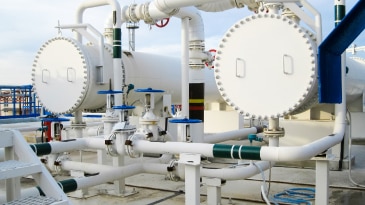
Aspen Exchanger Design & Rating Family
Heat exchangers can comprise up to 30% of capital equipment and impact 90% of the energy used in a process plant.
Brochure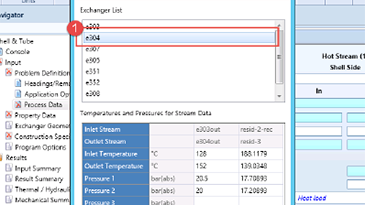
Jump Start Guide to using Aspen Shell & Tube Exchanger
Aspen Exchanger Design and Rating (EDR) enables you to find the optimal design for your heat exchanger needs based on cost. The seamless integration between the thermal and mechanical design tools of ...
Self-Guided Demo
Learn the top 10 Best Practices in Designing Heat Exchangers for the Process Industry
Optimal heat exchanger design software is vital for the efficient operation of any process plant. The integration between heat exchanger design and rating software, Aspen EDR, and the process simulato...
On-Demand Webinar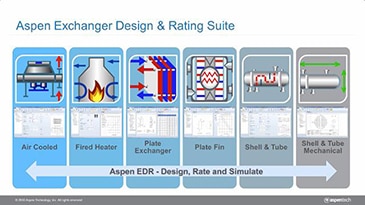
Activated EDR in Aspen HYSYS
Learn how to save on energy, CAPEX and OPEX by improving the fidelity of your process simulation flowsheets using rigorous heat exchanger models. Now it is easier than ever to generate rigorous heat e...
Video
European Engineering Company Saves $400,000 USD on CAPEX Using Performance Engineering
Discover how PETROLTERV saved significant CAPEX on a revamp project due to greater design accuracy enabled by the integrated aspenONE Engineering suite of products. Due to efficiencies gained from usi...
Case Study
Solution Demonstration: How to Accelerate Feasibility & Delivery of Capital Projects
This video showcases the streamlined workflow enabled by AspenTech Concurrent Engineering applied to a carbon capture project. The workflow enables the creation of state-of-the-art process simulation,...
Video
Graham Hart Delivers Highly Engineered Heat Transfer Equipment with aspenONE®
Graham Hart, a supplier of engineered process systems, supplying heat exchangers and high-pressure equipment to clients worldwide, achieves 97% on time delivery of complex heat exchangers with Aspen H...
Case Study